June 17, 2026 • Doug Porter • 10 min reading time • Prices verified June 25, 2026
Fireproof Photo Storage Boxes: Do They Actually Protect Prints When Disaster Strikes?
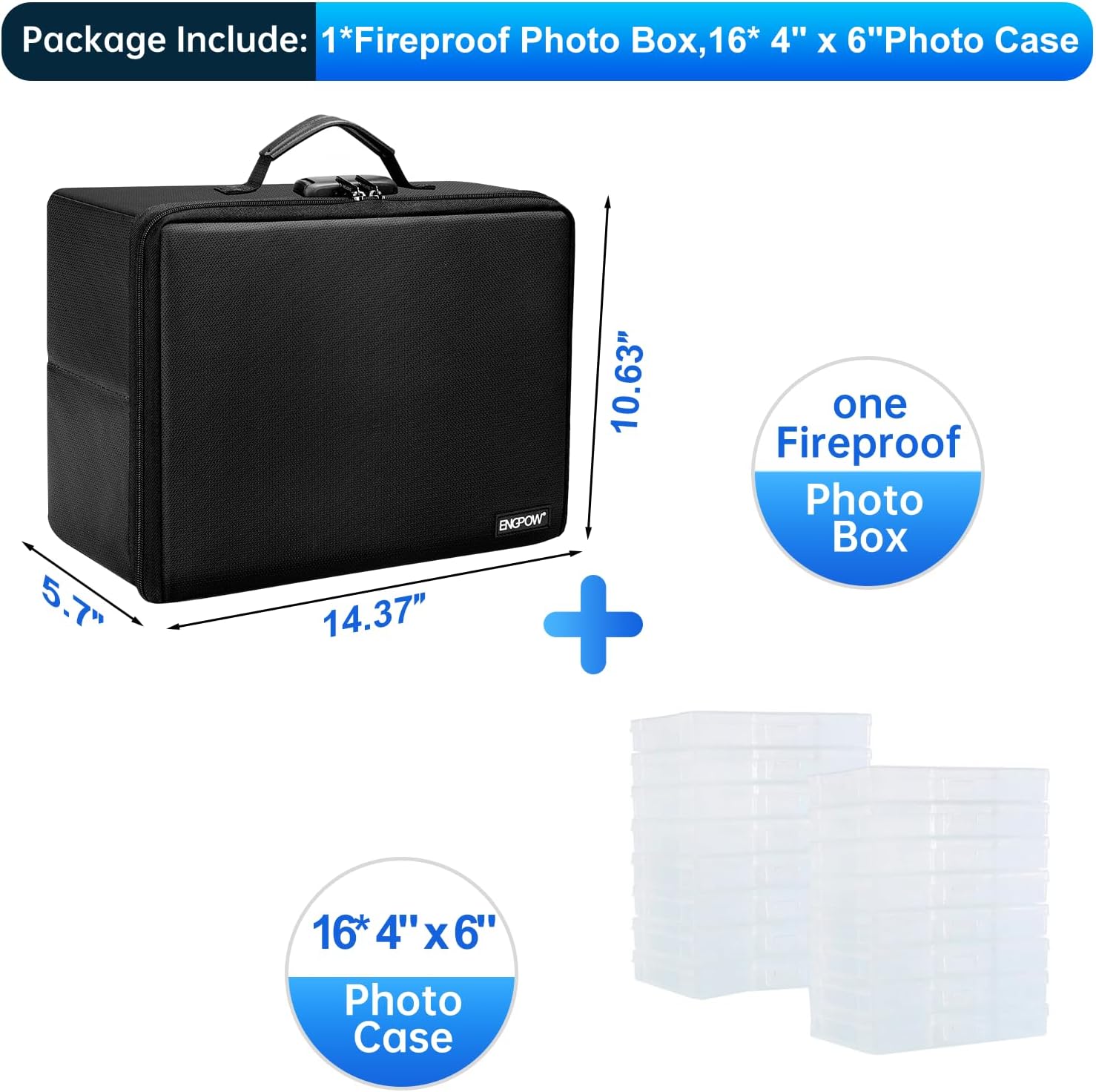
That box of old prints you just unearthed — the ones of your grandmother’s wedding, your dad’s Little League team, a Christmas morning from 1974 — represents something that cannot be recreated. A scan is a copy. The original print, with its particular paper texture and faded chemical warmth, is singular. So when a product promises to protect those originals from fire, it’s natural to want to believe it. The products in question are consumer photo storage boxes — rigid, lockable cases marketed with the word “fireproof” prominently on the packaging — and they’ve built a loyal following among family historians who are done with cardboard shoeboxes. Before you trust your most irreplaceable items to one, though, you deserve a clear-eyed look at what that “fireproof” label actually means, what these boxes genuinely do well, and where their real limits lie.
This article is for the buyer who already knows they need something better than a cardboard box and is now trying to decide whether a dedicated photo storage box is the right answer — or whether they need to step up to something with certified fire protection. We’ll show you the math, name the tradeoffs, and end with a decision framework you can use today.
What “Fireproof” Actually Means — and What It Doesn’t
Let’s start with the term that’s doing the most work on these product pages. “Fireproof” in everyday marketing language is almost always an unverified claim on consumer-grade storage products. It is not the same thing as a UL-rated fire rating.
The relevant standard is UL 72 (Underwriters Laboratories Standard for Tests for Fire Resistance of Record Protection Equipment). A product earning a UL 72 Class 350 rating — the baseline for paper documents — has been independently tested to prove that the interior temperature stays below 350°F (177°C) for a specified duration (typically 30 minutes, 1 hour, or 2 hours) while the exterior is exposed to a fire reaching 1,700°F. A Class 150 rating, more relevant for photographic media and magnetic media, keeps the interior below 150°F — because color photographic prints begin to sustain damage well below the temperature that destroys paper. Per the Image Permanence Institute’s consumer guide on print stability, photographic media is far more thermally sensitive than paper, meaning a box that keeps paper intact can still cook your prints.
Consumer photo storage boxes marketed as “fireproof” — including the ENGPOW Photo Storage Box and the Fireproof Safe Photo Storage Box — carry none of these third-party certifications in their published product listings as of May 2026. What they likely offer is fire-retardant construction: materials that resist igniting and slow heat transfer, which is meaningfully better than cardboard, but is not the same as a tested, rated safe.
The Society of American Archivists’ Glossary of Archival and Records Terminology draws a clear line between “fire-resistant” (tested, rated) and “fire-retardant” (materials that resist ignition but offer no guaranteed performance envelope). When you see “fireproof” on a consumer box without a UL or equivalent mark, you are looking at marketing language, not a verified specification.
This is not a reason to dismiss these products. It is a reason to understand precisely what you’re buying.
What These Boxes Are Actually Good At (Which Is More Than You Might Expect)
Here’s where the honest picture gets more balanced. Across aggregated buyer reviews of both the ENGPOW and Fireproof Safe Photo Storage Box products, the pattern is consistent: owners are enthusiastic, but their praise clusters around four specific benefits that have nothing to do with fire testing.
Organization. The inner case system — typically six to eight individual sub-cases within a larger outer box — lets owners sort by decade, by person, or by event. Reviewers repeatedly describe this as the first time their collection felt manageable. Multiple buyers across both products note they ordered additional units after their collections outgrew the first box. That’s a real signal: people are committing to these as a long-term system, not a one-time purchase.
Environmental protection. A rigid, latching box with a seal protects prints against three of the most common slow-motion killers: humidity fluctuation, dust accumulation, and light exposure. The Library of Congress’s preservation guidance for photographs consistently lists light, humidity, and pollutants as primary degradation agents for color prints — and a sealed, opaque box addresses all three. This is genuinely archival-adjacent behavior, even if the boxes aren’t certified archival materials.
Portability in an emergency. This is the benefit that reviewers feel most acutely. Grabbing a single handled box during an evacuation is meaningfully better than grabbing nothing because your photos were distributed across twelve different shoeboxes. The emotional reassurance of “I know exactly where everything is and I can carry it” is not trivial — it’s the difference between photos surviving a wildfire evacuation and photos that didn’t make it to the car.
Sturdiness and stackability. Reviewers consistently describe these boxes as rigid enough for shelf storage under weight. One usability detail worth flagging honestly: ENGPOW owners note the latches are stiff when new, requiring some break-in before they operate smoothly. This is minor but worth knowing if you’re planning to hand these boxes to an elderly parent or someone with limited hand strength.
The Archival Safety Question: Acid-Free or Not?
This matters more than most buyers realize, and it’s where the product listings get vague. “Acid-free” (meaning materials with a pH of 7.0 or higher that won’t off-gas acids that accelerate print deterioration) is a separate certification from fire resistance, and neither the ENGPOW nor the Fireproof Safe Photo Storage Box product listings make explicit acid-free claims in their published specifications as of this writing.
The Library of Congress preservation guidance is unambiguous: long-term storage of original photographic prints requires acid-free, lignin-free enclosures. Plastic components should be made from stable polymers — polyethylene, polypropylene, or polyester (Mylar) — not PVC, which off-gasses chlorine compounds over time.
If you’re storing prints you intend to preserve for decades, the conservative move is to sleeve individual prints in certified acid-free polypropylene or polyester sleeves before placing them in the inner cases. This adds cost and handling time, but it creates a buffer between your prints and any materials in the box that haven’t been independently certified as inert. Think of the box as your organizational and environmental outer shell; think of the sleeves as the actual archival interface.
By the Numbers
| Metric | Consumer Photo Box (ENGPOW / Fireproof Safe) | UL 72 Class 350 Fire Safe |
|---|---|---|
| Fire certification | None published | UL-rated, tested to 1,700°F exterior |
| Interior temp in fire | Unknown / unspecified | ≤350°F for rated duration |
| Adequate for photographic media? | Fire: unverified. Dust/light/humidity: yes | Only if Class 150 rated (≤150°F interior) |
| Typical 4×6 capacity per inner case | ~50–75 prints (per owner reports) | N/A — format varies by safe model |
| Estimated 4×6 capacity, full box | ~400–600 prints across all inner cases | N/A |
| Acid-free certified | Not specified in published listings | Varies by model |
| Price tier (May 2026) | $30–$70 per box | $80–$400+ depending on rating and size |
Decision Framework: Which Situation Calls for What
This is the “if X, then Y” section. No hedging.
If your goal is organizing prints that are already digitized and backed up, a consumer photo storage box is an excellent choice. You’re not betting your only copy on it — you have digital backups — so what you need is environmental protection, portability, and organization. These boxes deliver all three. The “fireproof” label is a bonus that may or may not perform under pressure, but it’s not load-bearing for your preservation strategy because your strategy already includes digital redundancy.
If your goal is protecting original prints that have NOT been digitized, a consumer photo storage box is a reasonable interim solution but should not be your endpoint. The fire-resistance claim is unverified, and these prints are irreplaceable. Your priority should be digitizing them first (even a prosumer flatbed scanner in the $200–$500 range changes your risk profile dramatically), then storing originals in a UL Class 150-rated fire safe — which is specifically tested to the temperature threshold relevant to photographic media.
If you are a small archive, estate service, or photo lab managing collections on behalf of clients, the liability calculus is different. Marketing a storage solution as “fireproof” to clients when the underlying product has no UL rating is a professional risk. Use UL-certified media safes for originals, and treat consumer photo boxes as organizational workflow tools, not as archival storage.
If you’re deciding between one box or multiple boxes, buy for your actual collection size, not your current one. The consistent reviewer pattern of “I ordered more because I ran out of space” suggests buyers underestimate their collections. Measure your existing prints, calculate at roughly 50–75 prints per inner case, and order accordingly.
Frequently Asked Questions
How many 4×6 photos actually fit in one inner case and in the full box? Based on owner reports across aggregated reviews, each inner case holds approximately 50–75 standard 4×6 prints, depending on whether they’re sleeved. A full box with six to eight inner cases can hold roughly 400–600 prints total. Larger or odd-format prints will reduce that capacity.
Are these boxes truly fireproof or is that a marketing claim? It is a marketing claim. Neither the ENGPOW nor the Fireproof Safe Photo Storage Box carries a published UL 72 or equivalent third-party fire-resistance certification as of May 2026. The materials likely offer some fire-retardant properties, but there is no verified performance envelope. Do not treat “fireproof” on these products the way you would treat a UL rating on a certified safe.
Can the inner cases be purchased separately if I run out of space? Availability of inner cases as standalone purchases varies by retailer and changes over time. Check current listings for each product — some sellers offer refill cases; others do not. This is worth verifying before you commit to a system, since it affects long-term scalability.
Are these boxes acid-free and safe for long-term archival storage of original prints? The published product listings do not make explicit acid-free claims. For long-term archival storage, the conservative approach is to sleeve prints in certified acid-free polypropylene or polyester sleeves before placing them in the box, creating an archival barrier regardless of the box material’s pH.
Will the lock keep children out or is it just a basic latch? These are basic latching locks, not security locks. They will deter casual access by young children but are not designed to resist a determined older child or adult. Do not rely on the lock for security — its purpose is to keep the lid closed during transport and storage.
Is the box rigid enough to be stored under weight on a shelf? Owner reviews consistently describe the outer case as rigid and suitable for shelf storage with other items stacked on top. No structural failures are reported in aggregated reviews, though long-term load performance under very heavy weight remains unverified by independent testing.
The honest summary: these boxes are genuinely useful products that have found a real audience for good reasons — organization, environmental protection, and grab-and-go emergency readiness. What they are not is a substitute for a UL-certified fire safe if your originals haven’t been digitized. Know which problem you’re actually solving, and these boxes can be a meaningful part of a layered preservation strategy rather than a false sense of security.