June 29, 2026 • Doug Porter • 12 min reading time • Prices verified June 25, 2026
Archival Negative Sleeves Compared: Print File, eTone, and Budget Alternatives Across 35mm and 120 Formats
That box of negatives sitting in your closet — the strip of 35mm from your parents’ wedding, the 120 roll from a grandfather who shot medium-format portraits — is already in danger. Film negatives are chemically active. Left in the wrong sleeve, a manila envelope, or a zip-lock bag, they off-gas acids that eat into the emulsion over decades. The fix is simple and cheap: archival negative sleeves — polypropylene or polyethylene plastic pages designed to be chemically inert — stored in a three-ring binder. But not all sleeves are created equal, and the wrong purchase means wasted money, unusable bottom rows, binders that won’t close, and a labeling nightmare you’ll inherit from your past self. This guide breaks down the two dominant brands — Print File and eTone — against budget alternatives, across both 35mm and 120 medium-format film, so you can make a defensible choice before your cart hits checkout.
Why Material Chemistry Actually Matters Here
The two materials you’ll encounter are polypropylene (PP) and polyethylene (PE). Both are considered safe for long-term archival storage when manufactured to the right standard, but they behave differently in practice.
Polypropylene is stiffer, clearer, and easier to write on. It holds its shape under the weight of a full binder and lets you read frame numbers through the sleeve without opening it — useful when cross-referencing with a contact sheet. The tradeoff: polypropylene can be slightly more prone to static buildup, which attracts dust to your negatives during insertion and removal.
Polyethylene is softer and more flexible, which some film handlers prefer because it is gentler during insertion. It tends to be slightly less optically clear, making contact printing through the sleeve a bit murkier. For most archivists, PE is fine; for anyone doing wet darkroom contact prints directly through the sleeve, PP is the better choice.
The Library of Congress Preservation Directorate, in its guidance document “Care, Handling, and Storage of Photographs,” specifies that storage enclosures should be manufactured from chemically stable plastics such as polyester, polypropylene, or polyethylene and should pass the Photographic Activity Test (PAT) — an industry standard confirming a material will not chemically damage film over time. When a sleeve manufacturer claims “archival quality,” PAT certification is the specific credential to look for. The Image Permanence Institute at Rochester Institute of Technology, in its publication “A Consumer Guide for the Archival Storage of Photographic Materials,” cites PAT compliance as the minimum bar for any film enclosure intended for long-term preservation.
The Three Tiers: How Print File, eTone, and Budget Sleeves Stack Up
The market breaks cleanly into three tiers: a premium option with a six-decade institutional track record, a mid-tier option with a smarter page geometry that solves a real manufacturing problem, and a budget tier where chemistry documentation becomes your primary due-diligence task. Each tier has a distinct audience and a distinct set of acceptable risks.
Print File: Premium Tier
Print File has been manufacturing archival enclosures since 1965. The “industry standard” label that appears across independent buyer discussions at B&H Photo Video is not marketing copy — it reflects decades of consistent manufacturing quality and broad format coverage. The Society of American Archivists, in its photographic materials handling guidance published through archivists.org, consistently directs practitioners toward PAT-certified polypropylene enclosures, and Print File’s 35mm sleeves are among the most frequently referenced examples in professional archival contexts.
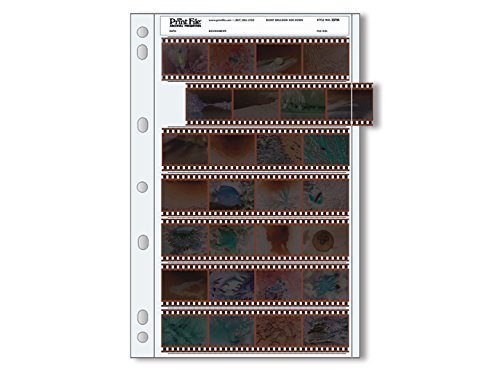
For 35mm film, the most common Print File configuration is the 7-strip-of-5 layout (seven horizontal strips, each holding five frames, meaning a 36-exposure roll fits with one frame to spare) and the 7-strip-of-6 layout for contact-sheet workflows. Buyers report that strips load cleanly, the polypropylene stays rigid under a full binder’s load, and punched holes align reliably with standard three-ring binders across multiple years of use.
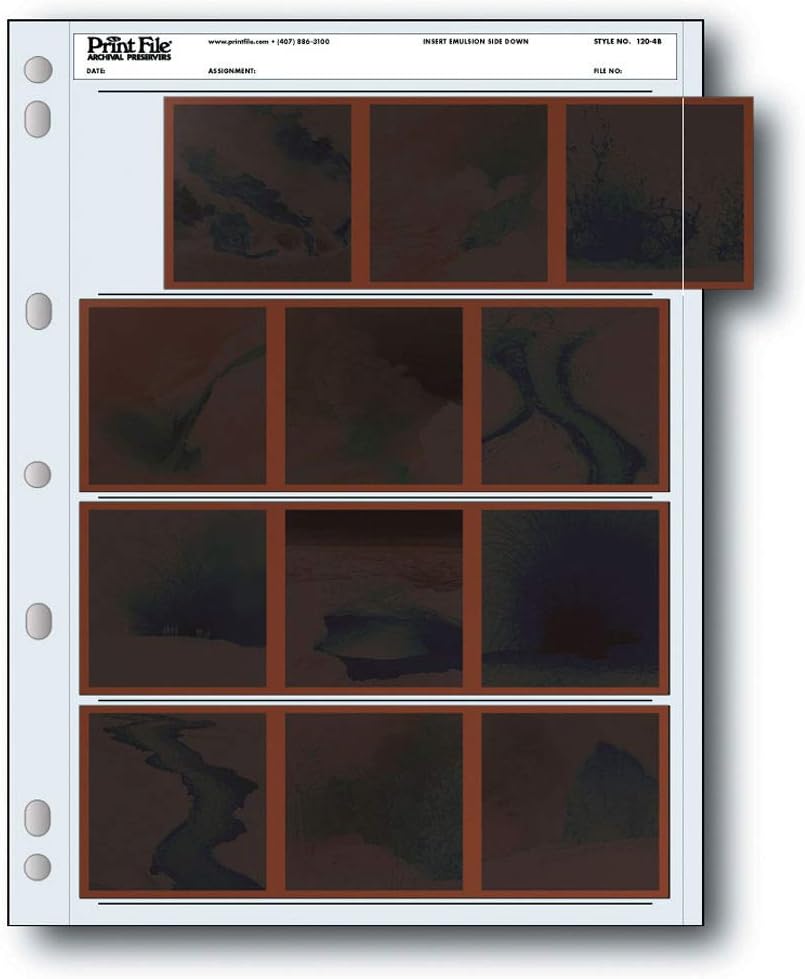
For 120 medium format, Print File produces sleeves in several configurations depending on frame count — 6×4.5 cm, 6×6 cm, 6×7 cm, and 6×9 cm all have different numbers of frames per roll and require correspondingly different sleeve layouts. This is where first-time buyers get caught: 120 sleeves are physically wider than 35mm sleeves, and the binders required are oversize, not standard letter-size three-ring binders.
The tradeoff: price. At B&H Photo Video, Print File sleeves consistently run at a per-sheet premium compared to eTone. When buying at volume — 100 sheets to archive a family estate — that gap compounds quickly. For a museum digitization project where the storage decision needs to survive institutional review, Print File’s documented paper trail justifies the premium. For a practitioner archiving personal negatives, the cost difference deserves honest scrutiny.
Plustek
$539.00
In stock on Amazon
Check price on AmazoneTone: Mid-Tier
eTone entered the market as a lower-cost alternative, and for some time that framing undersold a genuine engineering choice. The eTone 6-wide/7-tall layout — six frames across, seven rows down — changes the page geometry in a way that matters: it eliminates the problem of the “dead bottom row.”
Here is the specific manufacturing defect that has driven multiple independent reviewers to switch from competing 4-wide sleeve designs: in many budget (and some mid-tier) 4-wide archival sheets, the bottom row of pockets is cut inconsistently during production. The pocket openings are either too narrow, misaligned with the film strip, or partially sealed. In practice, the last strip of film on every page either will not insert cleanly, sits crooked, or risks scratching during removal. Buyers in B&H Photo Video product Q&A threads report discovering this defect only after filling most of a binder — at which point switching products means partially re-sleeving everything.
The eTone 6-wide/7-tall design sidesteps this by distributing the cutting geometry differently. Reviewers who made the switch specifically cite consistent pocket quality across all rows, including the bottom, as the deciding factor. That is a concrete quality signal, not a marketing claim.
The eTone bundled binder kit — sleeves plus a matching binder, sold together — is praised by buyers who compared it against purchasing Print File sleeves and a separate archival binder at B&H individually. The bundled price regularly comes in meaningfully lower for equivalent capacity, which matters when outfitting a full archival workflow.
The tradeoff: brand longevity. Print File’s 60-year track record is a real credential. eTone is a newer entrant with a shorter history of documented long-term performance, and while their materials are sold as PAT-certified, independent lab verification across decades does not yet exist. For personal archiving, that is an acceptable risk. For institutional projects, it requires more scrutiny.
$12.68
In stock on Amazon
Check price on AmazonBudget Alternatives: Where to Draw the Line
Generic sleeves from unbranded or lightly branded sources exist at a fraction of the price of either Print File or eTone. The honest assessment, drawing on the Image Permanence Institute’s “A Consumer Guide for the Archival Storage of Photographic Materials” and aggregated buyer feedback at B&H Photo Video, is that the risk is real but concentrated in two specific failure modes.
First: unknown PAT certification status. If the product listing does not explicitly state PAT compliance and the manufacturer cannot produce documentation, you are gambling with chemistry. The film may look fine at five years. At twenty, you will not know until the damage is already done.
Second: inconsistent manufacturing tolerances. The dead-bottom-row problem described above is more common in budget sleeves, not less. It is a recurring quality failure across multiple product categories documented in buyer feedback.
The decision rule: if the negatives are irreplaceable — family history, original art, archival documents — do not optimize for sleeve cost. The sleeves are the cheapest component of your archival system; a scanner, a binder, and your time all cost more. If you are sleeving film that exists as a verified digital backup and you are storing negatives as secondary redundancy, budget sleeves are a defensible choice, provided you obtain written PAT documentation from the manufacturer before purchasing at volume.
$11.70
In stock on Amazon
Check price on AmazonThe 120 Format Binder Problem (Do Not Skip This)
This is the most common expensive mistake in medium-format archival storage: buying 120 sleeves and discovering after the fact that they do not fit a standard letter-size three-ring binder.
120 film is physically wider than 35mm. A 6×6 or 6×7 negative sleeve sheet requires a larger binder — typically an oversize or 11×14 format archival binder, not the letter-size binders used for 35mm. Print File sells compatible oversize binders. eTone’s bundled kits for 120 include the correct binder. But if you buy the sleeves separately and source the binder elsewhere, you need to confirm ring spacing matches before anything ships.
Buyers who discover this mismatch after filling 40 sheets of medium-format negatives face two bad options: repackage everything or buy an entirely separate binder system. Neither is a pleasant afternoon.
Capacity Reference Table
| Format | Sleeve layout | Rolls per sheet | Sheets per 100-roll archive |
|---|---|---|---|
| 35mm | 7 strips × 5 frames | ~1 roll (36 exp.) | ~100 sheets |
| 35mm | 7 strips × 6 frames | ~1 roll + surplus | ~85–90 sheets |
| 120 (6×6) | 4 strips × 3 frames | ~1 roll (12 exp.) | ~100 sheets |
| 120 (6×7) | 3 strips × 3 frames | ~1 roll (10 exp.) | ~100 sheets |
A standard archival binder holds roughly 20–25 sheets, which means a 100-roll 35mm archive requires four to five binders. Plan your storage system before your first order — buying one binder at a time costs more per unit and creates format inconsistency across a growing collection.
Labeling and Cataloging: Build the System Before You Fill the Sleeves
Multiple buyers across Print File, eTone, and budget sleeve reviews share the same regret: they started filling sleeves before establishing a numbering system, and by roll 30 had no reliable way to locate a specific frame without flipping through everything.
The fix takes 20 minutes before you start. Decide on a scheme — most practitioners use a combination of year, roll number, and binder number (for example, “2024-R014-B2” for the fourteenth roll of 2024, stored in binder two) — and write it on both the sleeve sheet tab and a corresponding log. The Society of American Archivists’ photographic materials handling guidance, available through archivists.org, recommends that every enclosure carry a unique identifier linking to a finding aid — even a handwritten one — before materials are filed.
The eTone bundled kits include binders with spine labeling panels, a small but genuinely useful detail when building a multi-binder system from scratch.
Decision Rules: If X, Then Y
If you are archiving irreplaceable negatives and need documented PAT certification with a long institutional track record: Print File is the right call. Pay the premium; the paper trail justifies it.
If you are outfitting a volume workflow and the cost difference between Print File and eTone is meaningful at scale: eTone’s 6-wide/7-tall layout solves the dead-bottom-row problem that afflicts cheaper 4-wide alternatives, and the bundled binder kit pricing is a genuine advantage.
If you are storing 120 medium-format negatives: verify binder compatibility before anything ships. Both Print File and eTone offer format-appropriate solutions, but only if you purchase the right combination.
If you are considering generic budget sleeves: require PAT documentation from the manufacturer in writing. If they cannot produce it, the cost savings are not worth the archival risk on irreplaceable materials.
If you have not yet built your labeling system: do that first. The sleeves will wait. The frustration of an unlabeled 200-roll archive will not.
Frequently Asked Questions
What is the actual material difference between polypropylene and polyethylene negative sleeves, and which is safer for long-term storage?
Both are chemically stable and considered safe for archival use when PAT-certified, as confirmed by the Image Permanence Institute’s consumer guide for photographic storage materials. Polypropylene is stiffer and optically clearer, making it better suited for reading frame numbers through the sleeve and for contact printing. Polyethylene is softer and more flexible. For long-term storage, PAT certification matters more than which of the two materials you choose — verify that credential regardless.
Why do some negative sleeve sheets have unusable bottom rows, and how do I avoid buying those?
The problem is manufacturing tolerance: the bottom row of pockets is cut or heat-sealed inconsistently, leaving openings too narrow or misaligned to accept a film strip cleanly. It is more common in 4-wide layouts from budget manufacturers. The practical fix is to favor 6-wide designs such as eTone’s 7-tall layout, and to read buyer Q&A threads on any product at B&H Photo Video before purchasing at volume.
Do Print File and eTone sleeves fit the same standard three-ring binders?
35mm sleeves from both brands fit standard letter-size three-ring binders. 120 medium-format sleeves do not — they require oversize binders with wider ring spacing. Both brands offer compatible oversize binders for 120 format, and eTone’s bundled kits for medium format include the correct binder. Verify ring spacing before sourcing a binder separately.
How many rolls of 35mm film fit in a standard archival binder using 7-strip-of-5 sleeves?
A standard archival binder typically holds 20–25 sleeve sheets. At approximately one roll of 36-exposure film per sheet, that is roughly 20–25 rolls per binder. A 100-roll archive requires four to five binders.
Can I use the same binder and sleeve system for both 35mm and 120 medium-format negatives?
No. The physical dimensions are different enough that a single binder system will not accommodate both formats cleanly. Keep the two formats in separate dedicated binder systems and label each system clearly from the start.
What is the best way to label and index negative sleeves before I start filling them?
Establish a unique identifier scheme before your first roll goes in — year, roll number, and binder number is the most common practitioner approach. Write the identifier on the sleeve sheet’s tab and log it in a corresponding index, whether a spreadsheet or a handwritten card file. The Society of American Archivists recommends that every enclosure link to a finding aid before filing. Retroactively indexing 100 unsorted rolls is a miserable project; 20 minutes of setup at the start saves hours later.