June 18, 2026 • Doug Porter • 9 min reading time • Prices verified June 25, 2026
After the Scan, Protect the Original: Archival Negative Sleeves and Storage That Last
That box of film negatives sitting on your desk right now — the ones you just finished scanning — represents decades of moments that exist nowhere else on earth. The scan is done, and that digital file is safer than it was yesterday. But the original film strip is still vulnerable, and in most cases it’s still irreplaceable. A scratched or chemically degraded negative can’t be rescanned into better data than it currently holds; whatever information is there today is the ceiling for every future restoration attempt. Protecting that ceiling matters.
This guide is about what happens after the scanner lid closes: the sleeves, binders, boxes, and environmental conditions that determine whether your negatives are still readable in 2076. We’ll cover material science in plain English, flag the tradeoffs between the main product categories, and give you clear decision rules at each budget tier.
Why “Archival” Is Not Just Marketing Language
The word archival gets misused constantly, so let’s define it precisely. In preservation contexts, the term refers to materials that have passed one or both of two industry standards: ANSI/PIMA IT9.2 (the American National Standards test for photographic activity — essentially a chemical compatibility test) and ISO 18902, the international standard for albums, framing, and storage materials used with photographic images. The Society of American Archivists’ Glossary of Archival and Records Terminology defines archival-quality materials as those that are chemically stable, acid-free, and unlikely to react destructively with the items they contact.
The practical implication: a sleeve or envelope that hasn’t been tested to those standards may be off-gassing acids, plasticizers, or sulfur compounds that accelerate exactly the fading and brittleness you’re trying to prevent. Inert is the goal. And inert is testable — look for the phrase “passes PAT” (Photographic Activity Test) on packaging or product specs.
The Three Material Families You’ll Actually Choose Between
Polyethylene (PE): The budget-friendly, chemically inert workhorse. Clear, soft, and flexible. Manufacturer specs and archival supply vendors consistently confirm polyethylene has no plasticizers to migrate into film emulsion. The tradeoff is that it’s not optically crystal-clear — you’ll see a slight milky haze — and it generates static that attracts dust when you slide film in and out. For negatives going into long-term deep storage, PE sleeves represent excellent value.
Polypropylene (PP): Slightly stiffer, optically clearer than PE, and equally plasticizer-free. Owners and archivists in long-run reviews consistently prefer polypropylene for negatives they need to view and handle regularly — the clarity makes contact-sheet reading easier without a loupe. PP is the middle ground most practitioners land on.
Polyester (Melinex / Mylar): The premium choice. Published specs rate polyester as the most dimensionally stable of the three, meaning it won’t contract or expand with humidity changes nearly as much as PE. The Image Permanence Institute’s IPI Media Storage Quick Reference identifies polyester as the preferred sleeve material for master negatives and high-value originals. It’s also the most expensive and the stiffest — inserting fragile, curled 35mm strips takes more care than with PE.
What to avoid absolutely: PVC (polyvinyl chloride). PVC sleeves are cheap, slightly sticky, and everywhere in office supply stores. They off-gas hydrogen chloride as they age, and Wilhelm Imaging Research’s foundational work The Permanence and Care of Color Photographs documents the accelerated deterioration of film stored in PVC enclosures. If you’ve inherited a collection stored in PVC, re-sleeving is urgent.
Format Matters: Matching Sleeve Type to Your Film
Not all negatives are the same shape, and the wrong sleeve format creates its own damage risk — crimped edges, emulsion abrasion from oversize envelopes, or stress fractures in brittle acetate.
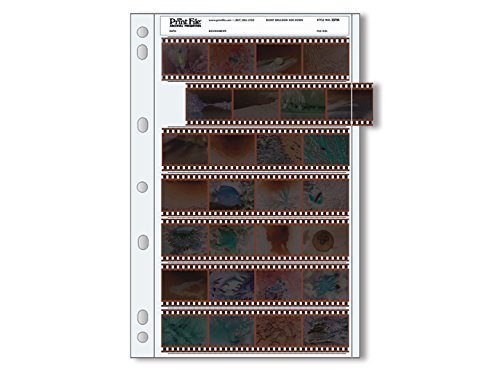
35mm (24×36mm frame): The most sleeve options exist here. Standard strips are cut to 6 frames; most binder pages hold 6 strips (36 frames per page). Pages designed for a 3-ring binder hold 7 strips in some formats — confirm the frame count matches your cut length before buying in bulk.
120 / Medium Format: 6×6, 6×7, and 6×9 negatives are larger and less standardized. Pages for 120 film typically hold 3 to 4 strips. If you’re working with a mix of 6×6 and 6×7 from the same shoot, you’ll need either adjustable-width sleeves or separate pages — forcing a 6×7 strip into a 6×6 sleeve creases the edges.
4×5 and Large Format Sheet Film: Individual sleeves, not strips. Each sheet gets its own envelope. The Library of Congress’s care and handling guidance recommends interleaving large-format sheet film with acid-free tissue when sleeves aren’t available, but dedicated polyester envelopes are the better long-term solution.
APS (Advanced Photo System) and 110: These smaller formats are often overlooked. APS cartridges should be stored in their cartridge with the cartridge door closed to protect unexposed or processed film — individual frame extraction without a proper APS scanner damages the cassette permanently. Dedicated APS storage pages exist but are increasingly hard to source; a padded acid-free box often works better for cartridge storage than strip sleeves.
By the Numbers
| Material | Passes PAT? | Optical Clarity | Static Risk | Relative Cost (per sleeve) |
|---|---|---|---|---|
| Polyethylene (PE) | Yes | Moderate (hazy) | High | $ |
| Polypropylene (PP) | Yes | Good | Moderate | $$ |
| Polyester (Mylar/Melinex) | Yes | Excellent | Low-Moderate | $$$ |
| PVC | No | Good | Low | $ (avoid entirely) |
Binders, Pages, and the Filing Architecture Decision
Individual sleeves solve the enclosure problem; they don’t solve the retrieval problem. For a working archive — one you’ll actually consult — filing architecture matters almost as much as material quality.
Hanging-file binder pages (the kind that punch into a 3-ring binder and hang the negative strip in a clear pocket) are the standard for working collections. The critical spec here is whether the page uses a side-loading or top-loading design. Side-loading pages require you to slide the strip in horizontally, which creates friction against the emulsion. Top-loading pages let you drop the strip in from above — lower contact, lower abrasion risk. B&H Photo’s archival storage category editorial notes consistently recommend top-loading pages for regular-access collections.
Print file binder pages (the brand Print File has become a generic term in the industry, the way “Kleenex” describes tissue) are the most widely stocked format in camera stores and archival supply houses. They’re polypropylene, reasonably priced, and available in every major film format. Owners in long-run reviews note they work well for medium-density collections — someone with 50 to 500 rolls — but the binder rings eventually cause the pages to hang unevenly under weight, which puts mechanical stress on the top pages.
Archival clamshell boxes paired with glassine or polyester envelopes are the preservation-first alternative. There are no rings to stress the material, no hanging weight, and the box itself provides a second layer of environmental buffering. The tradeoff is retrieval speed: finding a specific roll requires either meticulous labeling or a database. For long-term storage of originals you’ve already scanned and catalogued digitally, a box-based system is often the more rational choice.
Hybrid workflow: Many practitioners use binder pages for active scanning sessions and then migrate originals into archival boxes once the scanning project is complete and the digital files are verified. This separates the working-access phase from the permanent-storage phase without requiring you to maintain two parallel systems indefinitely.
Environment: The Factor That Outweighs All the Sleeves
Here’s the uncomfortable truth: a perfect polyester sleeve in a hot, humid attic will fail faster than a polypropylene sleeve in a climate-controlled room. Material choice and environmental conditions interact — they’re not independent variables.
The Image Permanence Institute’s media storage guidance sets the following targets for color negative film (the most demanding category):
- Temperature: 65°F (18°C) or below for active storage; below 35°F (-2°C) for long-term archival cold storage
- Relative Humidity: 30–50% RH, stable — swings matter as much as the absolute level
- Darkness: UV and visible light both accelerate dye fade; even LED room lighting adds cumulative exposure
For most home archivists, a climate-controlled interior room (away from exterior walls, attics, and basements) with a consumer-grade dehumidifier is achievable. Cold storage — a dedicated film freezer — is the gold standard for master originals, especially Kodachrome and pre-1980 Ektachrome with known instability profiles. Wilhelm Imaging Research’s data on Kodachrome’s stability under cold storage conditions shows projected preservation windows measured in centuries rather than decades.
One note on Kodachrome specifically: it cannot use IR-based dust removal during scanning (the dye layers block the infrared channel), which means physical dust and scratch damage is permanent in a way it isn’t for chromogenic films. This makes physical protection of Kodachrome originals especially non-negotiable — the scan cannot compensate for emulsion damage the way it can for other stocks.
The Decision Framework
If you’re choosing a storage system right now, here’s the if/then logic:
If your collection is under 100 rolls and you’re still actively scanning: Start with polypropylene binder pages in a standard 3-ring binder. Get them off the floor, away from humidity, and into labeled pages. This is a working system, not a permanent archive, and it’s fine to treat it that way.
If your collection is 100–500 rolls and scanning is complete: Migrate to top-loading polypropylene or polyester pages in a quality binder, stored in an archival clamshell box. Label every page and cross-reference to your digital catalog. The binder-in-box approach gives you the best of both retrieval and protection.
If you have high-value originals — Kodachrome, medium format art photography, family slides from the 1950s–1970s — or you’re managing collections for clients: Budget for individual polyester sleeves (they pass PAT and are dimensionally stable), clamshell archival boxes rated for photographic storage, and a cool-dark storage location with monitored humidity. If any single roll is irreplaceable, cold storage is worth the freezer cost.
If you’re a boutique studio or small institutional archive processing batches: The per-unit math changes. Buying polypropylene pages in bulk from archival suppliers (Gaylord Archival, Hollinger Metal Edge, and University Products are the three names that appear most consistently in institutional supply specifications) reduces per-sleeve cost significantly and ensures consistent PAT-tested material across the collection.
The scan gave you a safety net. The sleeve and the storage environment determine how long the original stays under that net — and whether you’ll ever need to fall back on a second scan from a film strip that’s still intact. That’s not a small thing. The original is irreplaceable. The storage system isn’t expensive. The math on which one to invest in is not complicated.