August 23, 2026 • Doug Porter • 12 min reading time • Prices verified June 25, 2026
Emergency-Ready Print Storage: Fireproof Photo Boxes, Archival Cases, and What 'Fireproof' Actually Guarantees
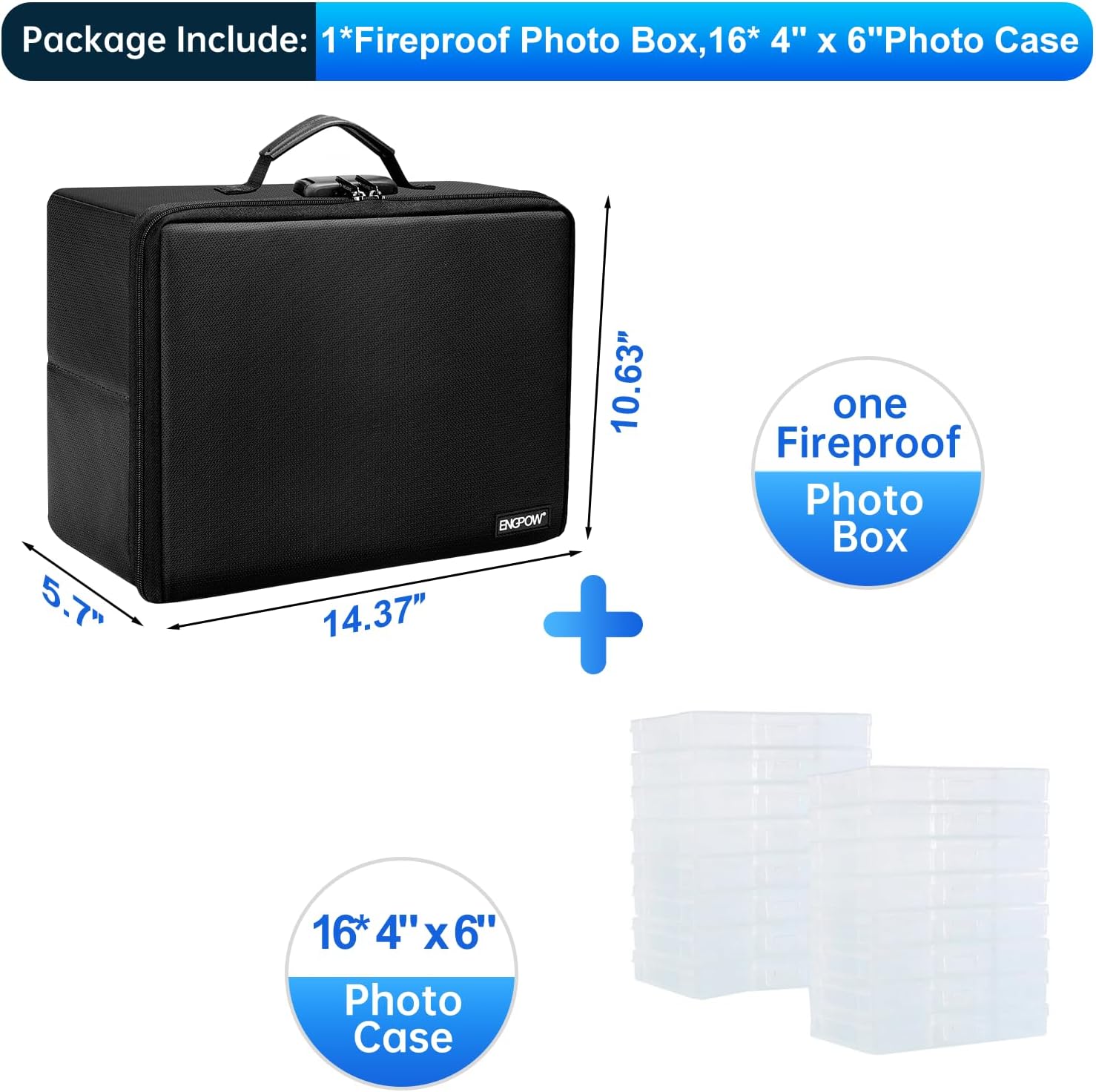
That box of photos in the closet — the one with the loose 4×6 prints from your parents’ anniversary party, the sleeve of negatives from a trip nobody can fully remember, the rubber-banded stack of school portraits going back to the 1970s — represents something that can’t be reprinted from a stock library or re-downloaded from a cloud account. It’s irreplaceable. And it is sitting in a cardboard box that would be ash in under two minutes in a house fire.
This guide is for the person who has already cleared that first mental hurdle: you know you need to protect these prints physically, not just digitally. You’ve probably encountered the term fireproof photo box in your research — a portable, latched metal or composite container rated to resist heat for a defined period — and you may have also come across archival storage, which means materials (boxes, sleeves, folders) made without the acids and off-gases that cause photographs to fade, yellow, and stick together over decades. These are two different problems, and right now there is no single consumer product that solves both completely. Understanding that gap — and building a simple two-layer system around it — is what this article is about.
What “Fireproof” Actually Means on the Label (And What It Doesn’t)
Let’s be direct: the word fireproof on a consumer product is marketing shorthand for a time-and-temperature rating. No box is fireproof in any absolute sense. What manufacturers actually certify is that the interior temperature stays below a defined threshold for a defined duration when the exterior is exposed to a standard test fire.
The relevant standard in North America is UL 72 (Underwriters Laboratories Standard 72 for Fire Resistance of Record Protection Equipment). Under UL 72, products are classified by what they protect:
- Class 350 protects paper documents — interior stays below 350°F (177°C), which is the approximate ignition point of paper.
- Class 150 protects magnetic media and microfilm — interior stays below 150°F (66°C).
- Class 125 protects digital media like USB drives and optical discs — interior stays below 125°F (52°C).
Here’s the wrinkle for photographs: photographic prints, negatives, and slides are more thermally sensitive than plain paper. Color prints begin to suffer irreversible dye damage well before 350°F. The Image Permanence Institute at Rochester Institute of Technology notes in its IPI Media Storage Quick Reference that color photographic materials should ideally be stored below 65°F for long-term archival stability — but for fire survival, the practical goal is keeping temperatures low enough that prints don’t scorch, melt, or fuse together. A Class 350 box may keep paper intact while your Kodachrome slides melt. A Class 150 box is meaningfully better for mixed photo media.
Duration matters as much as temperature. Most consumer-grade fireproof boxes are rated for 30 minutes at a specific temperature — typically around 1,550°F exterior (the standard UL 72 test condition). The National Fire Protection Association’s 2024 home fire statistics report notes that the average fire department response time to a residential fire in the U.S. is approximately 7 minutes, but structural fire exposure can continue for significantly longer before suppression is complete. A 30-minute rating provides a reasonable — not guaranteed — buffer for a typical residential scenario.
One more honest note: no consumer reviewer of any fireproof photo box on the market has actually confirmed fire survival in a real fire. Aggregate review patterns across products like the ENGPOW fireproof document box show consistent praise for build quality, latch sturdiness, and the modular inner case design — but fire performance data comes entirely from manufacturer testing and UL certification, not owner field reports. That’s not a knock on the products; it’s just the honest epistemic situation.
The Two-Layer System: Why You Need Both Archival and Fireproof Storage
The Society of American Archivists’ Preserving Your Family Archives fact sheet draws a clear line between two distinct threats to physical photographs:
- Slow chemical degradation — the acids in cardboard boxes, PVC sleeves, and rubber bands that break down emulsions over decades. This is what turns color prints magenta, makes black-and-white photos yellow, and causes negatives to stick to their enclosures.
- Acute physical disasters — fire, flood, and the physical trauma of a house emergency.
Archival materials (acid-free and lignin-free boxes, polyester or polypropylene sleeves, paper enclosures with a pH above 7.0) solve problem one. Fireproof boxes solve problem two. The problem is that the materials inside most fireproof boxes are emphatically not archival — they’re foam padding, plastic dividers, and generic fabric. Putting your prints directly into a fireproof box without archival enclosures means you’ve protected them from fire but not from the slow chemical damage that’s been degrading them for years already.
The solution is layering:
- Inner layer: acid-free sleeves or envelopes (polypropylene or polyester — avoid PVC, which off-gasses harmful chemicals) holding individual prints, negatives, and slides. Acid-free photo boxes or folders for grouping.
- Outer layer: a fireproof, portable container rated at Class 150 or better, sized to hold your archival enclosures.
This two-layer approach is not something any single off-the-shelf product currently provides. The Library of Congress’s Caring for Your Family Photographs resource recommends acid-free enclosures as the baseline for any physical storage, but it doesn’t address fireproofing — because institutional archives rely on fire-suppression systems rather than portable containers. For home and small-studio use, the combination is your responsibility to assemble.
Sizing the Problem: Capacity, Weight, and Grab-and-Go Realism
By the numbers — typical consumer fireproof box capacity:
| Box footprint (approx.) | Rated capacity (loose 4×6 prints) | Weight when loaded | UL rating |
|---|---|---|---|
| Small (10” × 8” × 5”) | 150–300 prints | 8–12 lbs | 30 min / 1,550°F |
| Medium (14” × 11” × 6”) | 400–700 prints | 15–22 lbs | 30 min / 1,550°F |
| Large (17” × 13” × 8”) | 800–1,200 prints | 25–40 lbs | 30 min / 1,550°F |
Capacity estimates are for loose prints without individual sleeves; sleeved prints reduce capacity by approximately 30–40%. Weights are for the box loaded with prints — the steel/composite construction adds 5–10 lbs before contents.
The “grab-and-go” appeal that reviewers of products like the ENGPOW box consistently cite is real, but it requires honest capacity planning. Owners frequently describe the emotional satisfaction of finally having one portable container for decades of a parent’s photos — the narrative of ditching a collection of deteriorating cardboard boxes for a single organized system resonates strongly across review aggregators. At the same time, reviewers note that a fully loaded large box approaches 35–40 pounds, which is genuinely not easy to carry under stress. The practical recommendation: two medium boxes rather than one large box, divided by decade or family branch, each manageable at under 20 pounds fully loaded.
Stiff latches on new units are the most consistent friction point in aggregated reviews. This is a design characteristic, not a defect — the tight seal is part of what creates the fire-resistant barrier. Owners report that latches loosen to comfortable operation within a few open-close cycles. Budget for this break-in period and don’t mistake a new box’s stiff latch for a malfunction.
Building Your Triage System: Sorting Before You Store
If you’re inheriting decades of unsorted prints — the classic scenario of a parent’s collection spread across multiple cardboard boxes, envelopes, and shoeboxes — the temptation is to transfer everything directly into the fireproof box without sorting. Resist this. Unsorted, loose prints stuffed into a fireproof container can abrade against each other, and without acid-free separators, adjacent prints continue to chemically interact.
A practical triage workflow before archival loading:
-
Rough chronological grouping first. You don’t need exact dates — broad decades are enough. Physical prints carry visual cues (print border styles, paper finish, format size) that correlate with eras. 1960s–70s prints tend toward glossy, smaller formats; 1980s prints often show the characteristic magenta-orange color shift of older Kodacolor processing; 1990s prints are frequently matte 4×6.
-
Condition sort within groups. Separate damaged or stuck prints — these need individual attention and potentially professional restoration before storage. Putting a damaged print in a sleeve accelerates its interaction with adjacent materials.
-
Prioritize highest-value items for individual sleeves. Not every print needs an individual polypropylene sleeve, but unique items — the only surviving image of a relative, wedding photos, military portraits — should each get their own enclosure before going into a grouped folder.
-
Label before you store. Acid-free labels or pencil notation on acid-free envelopes. Never use ballpoint or felt-tip directly on print backs — ink and solvent migration is a documented preservation problem cited in the Library of Congress guidelines.
The Society of American Archivists recommends the “scan the best first” principle when time is limited: identify the 20% of your collection that carries 80% of the irreplaceable value, digitize those first, then sort the remainder.
Negatives and Slides in a Fireproof Box: What You Need to Know
The short answer: yes, you can store negatives and slides alongside prints in a fireproof box, but they have different material requirements.
Negatives (whether cellulose acetate from the mid-20th century or polyester-base from the 1980s onward) should be stored in individual glassine or polypropylene sleeves, then in acid-free negative pages or envelopes. Acetate-base negatives are particularly vulnerable — they’re already undergoing slow decomposition (the characteristic “vinegar syndrome” smell is acetic acid off-gassing), and storing them in a sealed fireproof container without proper buffering can accelerate this. If your negatives have a noticeable vinegar smell, consult the Image Permanence Institute’s A-D Strips product guidance before sealing them in any enclosed container.
Kodachrome slides deserve a specific note because of their unique chemistry. Kodachrome’s cyan dye layer is exceptionally stable compared to most color film stocks — it’s the reason well-stored Kodachrome from the 1960s still looks vibrant while contemporary Ektachrome from the same era shows significant magenta shift. Store Kodachrome slides in polyester (Mylar) sleeves, not PVC pages, and keep them in the same archival layer as prints. One practical note relevant to the scanning workflow many readers are managing: Kodachrome’s dense dye structure means it does not respond to infrared dust-removal tools (ICE and similar systems) the way other slide films do. If you’re staging a scanning project alongside your physical storage upgrade, flag Kodachrome slides for manual cleaning before scanning — this doesn’t affect physical storage, but it affects your workflow planning.
Frequently Asked Questions
What temperature rating do I need for a fireproof box to actually protect photographs? Class 150 (interior stays below 150°F / 66°C) is the appropriate minimum for color prints, slides, and negatives. Class 350 — the most common consumer rating, designed for paper documents — allows interior temperatures that can damage photographic dye layers. Check manufacturer certification labels specifically for the UL 72 class rating, not just the duration.
How many 4×6 prints fit in one of these fireproof systems realistically? A medium-sized consumer fireproof box holds approximately 400–700 loose 4×6 prints. If you sleeve individual prints in polypropylene enclosures (recommended for anything valuable), reduce that estimate by 30–40%. For a collection of 1,000+ prints, plan on two medium boxes rather than one oversized unit.
Are the inner cases themselves acid-free or just the outer box? In virtually all current consumer fireproof photo boxes, including the ENGPOW and comparable products, the inner divider cases and foam inserts are not acid-free or archival-grade. They’re functional organizers, not preservation materials. This is why the two-layer approach matters: bring your own acid-free sleeves and envelopes as the inner layer, and use the fireproof box’s cases purely for physical organization and protection.
Can I store negatives and slides in these boxes alongside prints? Yes, with the right inner enclosures. Negatives need individual polypropylene or glassine sleeves; slides do best in polyester (Mylar) pages. Avoid PVC enclosures in any sealed container. If you have acetate-base negatives showing vinegar syndrome, consult the Image Permanence Institute’s guidance before sealing them in an enclosed box — off-gassing in a sealed environment can be counterproductive.
What is the difference between a fireproof box and an archival box, and do I need both? A fireproof box resists acute heat events for a rated duration. An archival box uses chemically neutral materials (acid-free, lignin-free) to prevent slow chemical degradation over decades. They solve completely different problems, and no single consumer product currently combines both. For irreplaceable materials, you need both — archival enclosures inside a fireproof container.
How do I organize decades of unsorted loose prints before putting them in a fireproof storage system? Start with rough decade groupings, then sort by condition within those groups. Prioritize the highest-value and most fragile items for individual acid-free sleeves first. Label folders or envelopes with pencil or acid-free labels before sealing — never ballpoint pen directly on print backs. The Society of American Archivists recommends identifying and digitizing your top 20% of irreplaceable images before investing time in sorting the full collection.
The Decision Rule
If your collection is primarily color prints and slides from the 1960s onward and you’re building an emergency-grab system on a realistic home budget, the path is clear: invest in a Class 150-rated fireproof box (not Class 350) large enough to hold two or three medium-capacity inner cases, pair it with a separate purchase of polypropylene sleeves and acid-free envelopes for the inner layer, and divide your collection into two portable boxes by weight rather than one heavy one. The fireproof box handles the acute disaster scenario. The acid-free enclosures handle the slow chemical one. Neither is optional if the materials matter to you.
If your collection includes acetate-base negatives with any off-gas smell, or Kodachrome slides you’re also planning to scan, stage those for individual assessment before sealing — the storage upgrade and the scanning workflow are decisions worth making together, not in sequence.